
Hillsdale County Trail Towns
Home of McCourtie Park
In the fall of 1833, Somerset Township was settled by Elias Alley, a craftsman from upstate New York who traveled the Sauk Trail to establish a new home in the Michigan wilderness. While the area began as a quiet rural crossroads, it eventually became the site of one of the state’s most whimsical landmarks: McCourtie Park. The estate was created by W.H.L. McCourtie, who returned to his hometown after making a fortune in Texas oil. As the owner of a cement company, McCourtie transformed his property, known as Aiden Lair, into a fantastical garden that serves as a unique monument to concrete folk art.
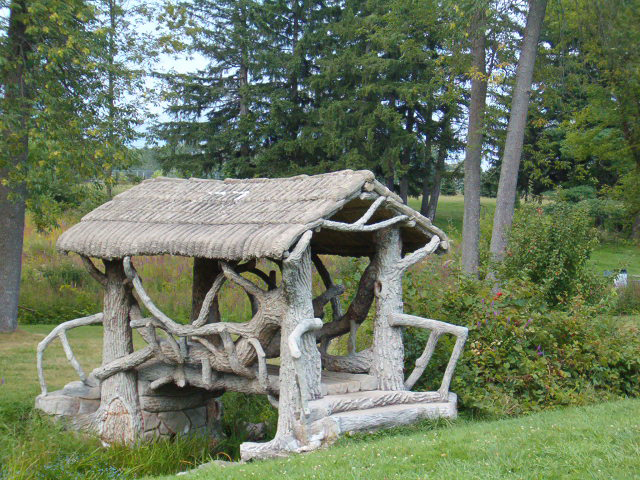
The centerpiece of the 42 acre park is a collection of 17 bridges crossing a meandering stream, all handcrafted in the early 1930s by Mexican artisans. These structures utilize a technique called faux bois, or “fake wood,” where concrete is sculpted and painted to look like natural timber. The park also features curious cement chimneys shaped like tree trunks that rise from an underground rathskeller built into a hillside. Local lore suggests this hidden room was a hub for high stakes poker games with Detroit industrial giants like Henry Ford, and that secret tunnels were used by bootleggers to smuggle liquor into the estate during those all night gatherings.
Beyond its eccentric architecture, Somerset Center is a significant hydrological landmark as the site of the headwaters for the Grand River. Michigan’s longest river begins here at natural springs before winding its way across the lower peninsula to Lake Michigan. For centuries before the advent of modern roads, the Grand River served as a vital navigational highway for Native American tribes, fur traders, and early settlers. Interestingly, the nearby River Raisin watershed flows in the opposite direction, eventually emptying into Lake Erie and marking Somerset as a unique continental divide in the Michigan landscape.